Pitching Process
Evaluation takes place in two rounds on Friday, September 25:
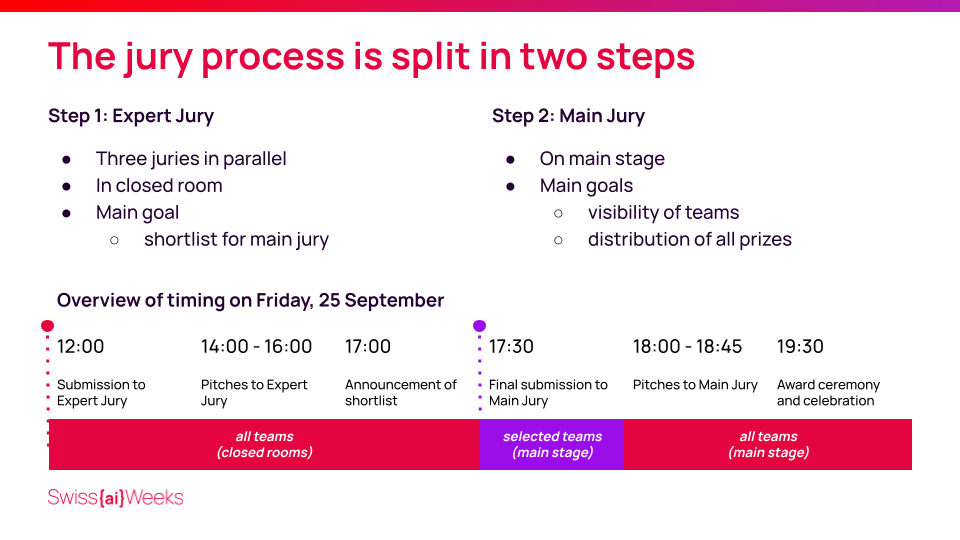
- Round 1: Expert Jury (All Teams)
- When: 14:00 – 16:00 (Submission deadline: 12:00)
- Setup: Pitches take place in a closed room across 3 parallel panels.
- Pitch Time: 4 minutes total (1-min pitch + 3-min Q&A).
- Submission: Submit to expert jury
- Goal: Shortlist selected teams for the main stage (announced at 17:00).
- Round 2: Main Jury (Selected Teams)
- When: 18:00 – 18:45 (Final submission deadline: 17:30)
- Setup: Pitches take place live on the main stage.
- Pitch Time: 3 minutes total (2-min pitch + 1-min Q&A).
- Submission: Via email: jury@swiss-ai-weeks.ch
- Goal: Team visibility, final winner selection, and prize distribution at the Award Ceremony (19:30).
*Please note the pitch timing
In the Expert Jury, you have 4 minutes (1 min pitch and 3 min Q&A)
In the Main Jury, you have 3 minutes (2 min pitch and 1 min Q&A)
Jury Rules
- Eligibility: The jury only evaluates projects submitted on time by registered teams where all members have a valid ticket and ID.
- Independence: The jury acts independently to select winners. Decisions are final and cannot be legally appealed.
- Conflicts of Interest: Any juror with a bias or personal interest in an outcome must declare it immediately and recuse themselves from voting.
- Moderator: The jury moderator holds the tie-breaking vote on all decisions.
Evaluation Criteria
Judging is qualitative. You do not need to provide formal quantitative proof.
Preferences
- Clean, reproducible code is preferred.
- Concepts and execution that leverage modern AI paradigms.
- For challenge submissions, the challenges objectives should be addressed.
Criteria
These criteria only structure the jury's discussion. The jury as a group may choose winners at its own discretion.
- Technical Functionality & AI: Does the solution work? Is the implementation technically sound and reproducible?
- User Experience: Is the solution intuitive, useful, and easy to use?
- Agentic Depth: Do autonomous agents handle complex logic?
- Originality & Fun Factor: Is the solution novel, surprising, or creatively engaging?
- Potential & Market Impact: Does it address a relevant problem? Can it grow beyond the hackathon? If applicable, does it meet the challenge objectives?